
Cloud Security Penetration Testing

Amazon, Google, and Microsoft secure the cloud. It is your job to secure what’s in the cloud. We find the misconfigurations they won't tell you about.


Cloud Security Penetration Testing

Amazon, Google, and Microsoft secure the cloud. It is your job to secure what’s in the cloud. We find the misconfigurations they won't tell you about.


THE REALITY CHECK

THE REALITY CHECK

The "Shared Responsibility" Trap

The "Shared Responsibility" Trap

Moving to the cloud doesn't mean you outsourced your security. It just means you changed the risks. The biggest threat to your cloud environment isn't a zero-day exploit in the Linux kernel—it’s a simple misconfiguration.


An S3 bucket left open to the public? A developer with Admin keys committed to GitHub? These are the mistakes that cause data leaks. We hunt them down before a bot does.

Penetration testing (or "pentesting") is a simulated, authorized cyberattack against your computer system to verify its security.


Unlike a vulnerability scan which simply lists potential issues based on a database, a penetration test involves a human engineer actively attempting to exploit those weaknesses. The goal is to prove exactly how an attacker could steal data, compromise users, or shut down operations so you can fix it before they do.

HOW WE BREAK IN

We Speak All The Dialects

We Speak All The Dialects

We Speak All The Dialects

Whether you’re on AWS, Azure, or GCP, the concepts are the same, but the kill chains are different.

Whether you’re on AWS, Azure, or GCP, the concepts are the same, but the kill chains are different.

Amazon Web Services


We look for the classics: overly permissive IAM roles, S3 buckets serving sensitive data to the world, and Lambda functions that let us pivot into your VPC. We test if a compromised EC2 instance allows us to take over the whole account.


Microsoft Azure


Azure Active Directory is a beast. We focus heavily on identity attacks, checking for "Global Admin" paths, misconfigured Service Principals, and storage blobs that shouldn't be public.

Google Cloud Platform


We analyze your IAM bindings and Service Accounts. We check Kubernetes (GKE) configurations to ensure a container breakout doesn't lead to a node takeover.

HUMANS VS. ROBOTS

HUMANS VS. ROBOTS

Automated Tools Can’t See Context

Automated Tools Can’t See Context

Cloud security tools (CSPMs) are noisy. They scream about every single issue, regardless of risk. They’ll tell you a security group is "open," but they won't tell you if it actually matters.

We act as the filter. We verify which findings are actual kill paths and which are just noise. We manually attempt to exploit these misconfigurations to prove the risk, so you aren't wasting engineering hours fixing things that don't matter.
THE PROCESS

How We Work

STEP 1

STEP 2

STEP 3

STEP 4

Access Setup

We create a dedicated "Auditor" role or Service Account. You don't need to give us root keys.

The Review & Attack

We combine configuration review (checking settings) with active exploitation (trying to break things).

The Report

We map out exactly which misconfigurations allow for data exfiltration.

The Retest

You tighten the policies. We check to make sure we can't get back in.

STEP 1

STEP 2

STEP 3

STEP 4

Access Setup

We create a dedicated "Auditor" role or Service Account. You don't need to give us root keys.

The Review & Attack

We combine configuration review (checking settings) with active exploitation (trying to break things).

The Report

We map out exactly which misconfigurations allow for data exfiltration.

The Retest

You tighten the policies. We check to make sure we can't get back in.

THE PROCESS

How We Work

How We Work

STEP 1

STEP 2

STEP 3

STEP 4

Access Setup

We create a dedicated "Auditor" role or Service Account. You don't need to give us root keys.

The Review & Attack

We combine configuration review (checking settings) with active exploitation (trying to break things).

The Report

We map out exactly which misconfigurations allow for data exfiltration.

The Retest

You tighten the policies. We check to make sure we can't get back in.

STEP 1

STEP 2

STEP 3

STEP 4

Access Setup

We create a dedicated "Auditor" role or Service Account. You don't need to give us root keys.

The Review & Attack

We combine configuration review (checking settings) with active exploitation (trying to break things).

The Report

We map out exactly which misconfigurations allow for data exfiltration.

The Retest

You tighten the policies. We check to make sure we can't get back in.

Powered by the Red Sentry PTaaS Platform

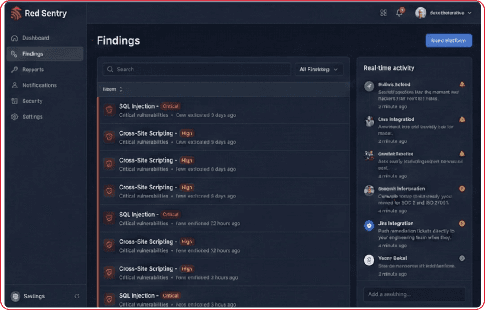
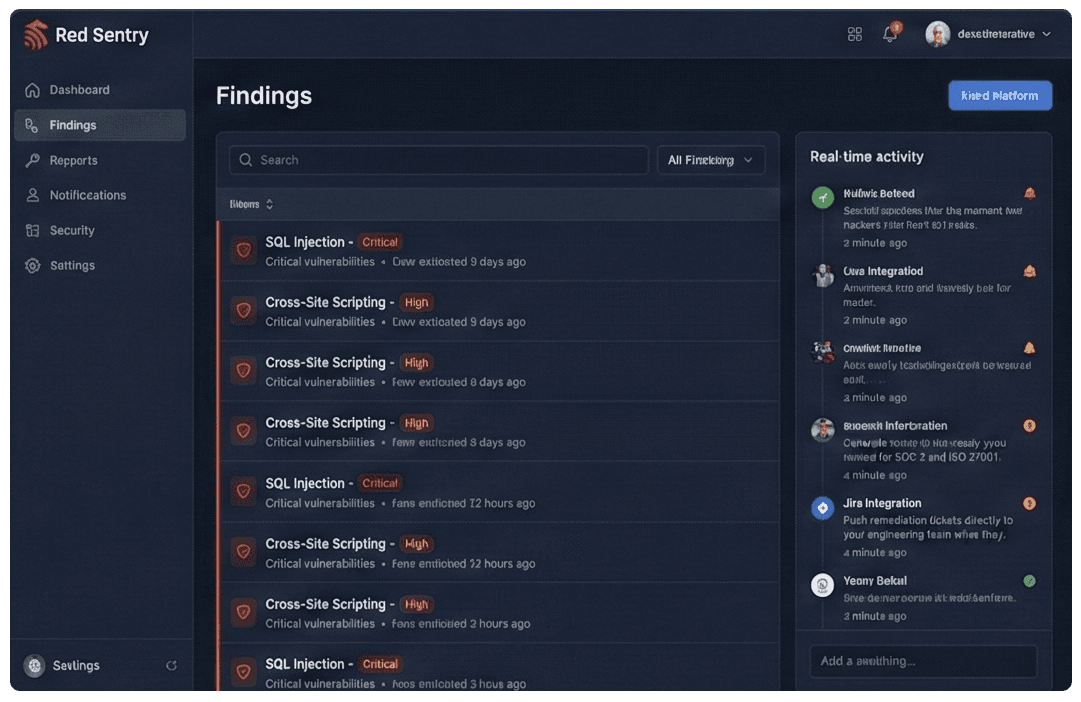
We don’t just hand you a static PDF and walk away. Every single engagement includes full access to our Penetration Testing as a Service (PTaaS) platform at no extra cost. It’s the modern way to manage your security without the headaches of email threads and spreadsheets.

Real-Time Visibility: See critical risks the moment our hackers find them so you can start fixing immediately.

Jira Integration: Push remediation tickets directly to your engineering team where they actually work.

One-Click Compliance: Generate the audit-ready reports you need for SOC 2 and ISO 27001 instantly.

Powered by the Red Sentry PTaaS Platform

We don’t just hand you a static PDF and walk away. Every single engagement includes full access to our Penetration Testing as a Service (PTaaS) platform at no extra cost. It’s the modern way to manage your security without the headaches of email threads and spreadsheets.

Real-Time Visibility: See critical risks the moment our hackers find them so you can start fixing immediately.

Jira Integration: Push remediation tickets directly to your engineering team where they actually work.

One-Click Compliance: Generate the audit-ready reports you need for SOC 2 and ISO 27001 instantly.

Close Your Buckets. Secure Your Keys.

The cloud is safe, provided you configured it correctly. Let’s double-check your work.

Close Your Buckets. Secure Your Keys.

The cloud is safe, provided you configured it correctly. Let’s double-check your work.

Close Your Buckets. Secure Your Keys.

The cloud is safe, provided you configured it correctly. Let’s double-check your work.