“Automated Pentesting”: My Opinion On Balancing Thoroughness & Efficiency in the Age of AI

“Automated Pentesting”: My Opinion On Balancing Thoroughness & Efficiency in the Age of AI
Valentina Flores
CEO
Automated pentesting promises speed and broad coverage by using software to check systems for known issues. It can be useful as a starting point, but without a human tester driving the work, it is closer to vulnerability scanning than a true pentest.
Penetration testing (pentesting), is a critical tool in the offensive cybersecurity space. It allows businesses and organizations to identify and address vulnerabilities and take the necessary security measures before malicious actors can gain access and exploit them.
Aside from the thousands of techniques used in these tests, there are two main approaches diverging: manual testing and automated tools.
A traditional pen test relies on the skill and intuition of human testers, with complex vulnerability chaining and creative social engineering leading to more critical vulnerabilities exposed. But recently, the phrase “automated pentesting” has risen in popularity. These solutions leverage software to carry out scans and simulations of potential attack scenarios. With the rise of AI, automated pentesting will be evolving even more over the next few years.
In this article, I’ll explore how we define the terms, the pros and cons of both methods, and the impact of artificial intelligence on the field of pentesting.
What is automated penetration testing?
Automated penetration testing uses software to scan systems for known vulnerabilities without a human driving the test. It is quick and inexpensive and useful for surface coverage, but on its own it is a vulnerability scan, not a penetration test.
Does automated pentesting actually exist?
How much automation counts as automated? How much exploitation counts as a pentest?
There aren’t single scientific definitions for these terms. Even the phrase “pentesting” can be vague, with different companies providing many different levels of service. So I respect all companies’ rights to define themselves however best suits their clients.
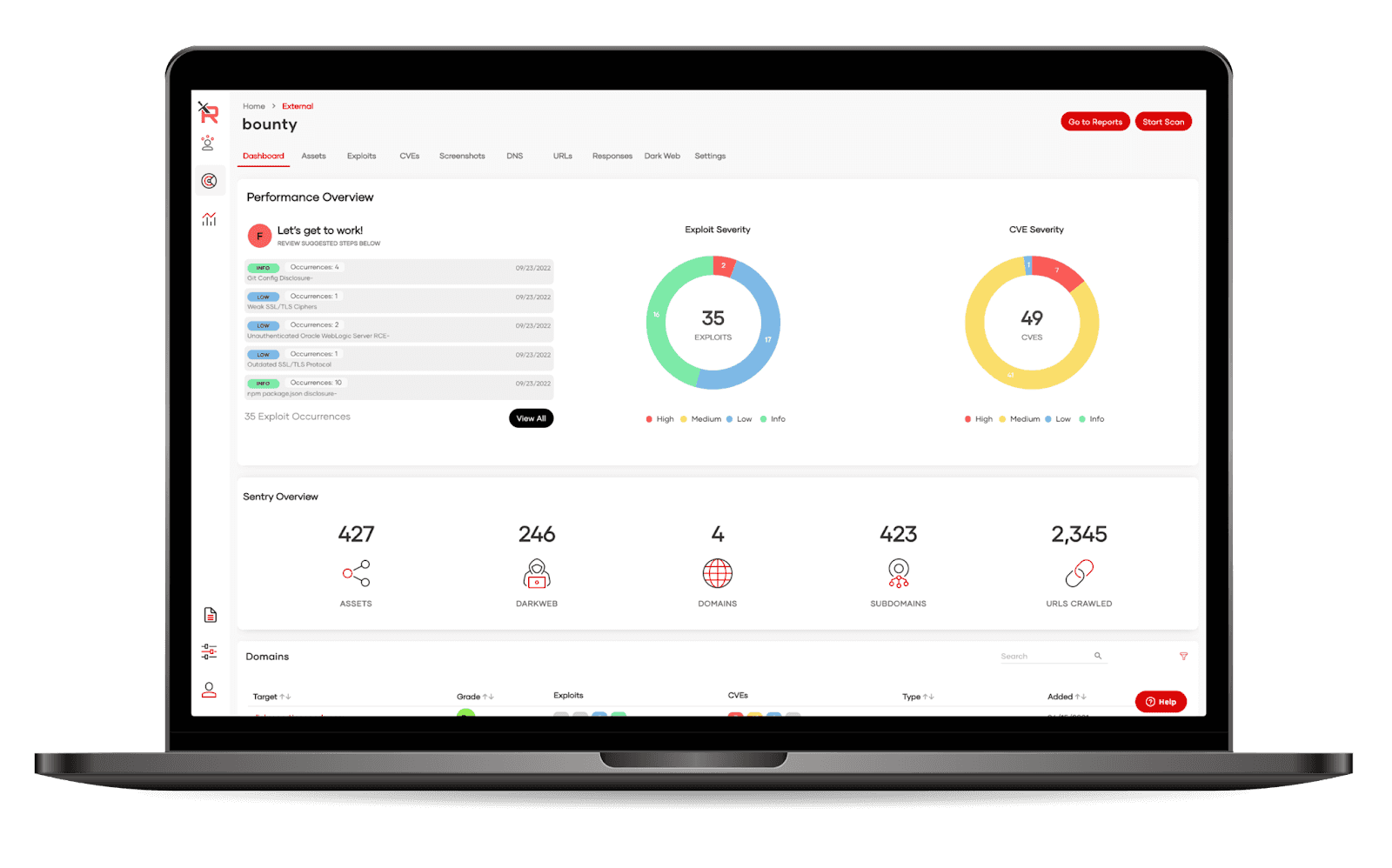
At Red Sentry, because we offer both traditional pentesting and a vulnerability management platform, we have been navigating terms like “automated pentesting” for years. At our inception, because our SaaS platform has an exploit engine and is providing proofs of concept, we called it an “automated pentest.” But as we grew in the space, we felt we were doing both our clients and our traditional pentesting branch a disservice by using this term, because automated tools simply cannot replace human testers (yet!).
So for now, we prefer the phrase “vulnerability management platform.” But as we add more machine learning capabilities and AI into the platform in the future, who knows!

Is automated penetration testing a real pen test?
No. A scanner finds the unlocked door, but it does not walk through it, chain weaknesses together, or test your business logic. Treating a scan as a pen test is the gap most buyers get burned by.
Automated vs human-led: what’s the difference?
Automated scan | “Automated pen test” (a scan in disguise) | Human-led pen test (Red Sentry) | |
|---|---|---|---|
Who runs it | Software, no human | Software, with a report stapled on | Certified human testers, using tools only to assist |
What it finds | Known CVEs and surface issues | The same as a scan, dressed up as a test | Chained exploits, business-logic flaws, real attack paths |
False positives | High | High | Low, every finding human-verified |
Is it really a pen test? | No, it is a scan | No, it is a scan sold as a pen test | Yes |
The art of penetration testing
We often think of pentesting as a science because it’s so deeply rooted in technology. But it is also an art!
At its core, pentesting is a creative process that requires expert knowledge and problem-solving skills to identify potential security weaknesses in complex systems. Manual penetration testing services use a variety of techniques, including social engineering, network scanning, and vulnerability analysis, to gain insight into potential attack vectors.
By thinking like a malicious hacker, a skilled pen tester can find vulnerabilities that automated tools might miss. For example, a pen tester may use psychological tactics to manipulate an employee into revealing sensitive information, something that a software tool would be less successful with.
In addition, ethical hackers are able to pivot better, because they can use creativity to chain together different vulnerabilities that may not be programmed into the exploit engines of automated pentest platforms.
The rise of automated tools
In recent years, the use of automated pentesting tools has skyrocketed due to the increasing complexity and scale of modern networks. These tools can scan large networks quickly, and identify potential vulnerabilities with a high degree of accuracy. They also generate detailed reports that can help organizations prioritize their remediation efforts and fix vulnerabilities.
However, all tools on the spectrum of vulnerability scanners to automated pentests have limitations. They can only identify vulnerabilities that are already known and documented, and they lack the creativity and intuition of human testers. Additionally, they may generate false positives or miss critical vulnerabilities that require a more nuanced approach.
Is automated pentesting enough on its own?
For most compliance and security needs, no. Auditors and enterprise customers expect human-led testing with verified findings. Automation is a starting point, not the deliverable.
The ethics of automated pentesting
The use of automated penetration testing tools raises important ethical considerations.
As consumers, organizations may be tempted to rely too heavily on automation, potentially overlooking critical vulnerabilities that only a human tester would be able to identify. Automated testing is often an easier option, but may not be enough to keep the organization secure.
As providers, we have ethical responsibilities to secure our clients’ environment, or at least help them understand the different options available to them and what we recommend as security experts. Explaining the advantages and limitations of both traditional and automated testing can help the client make the best decision for their business.
How Red Sentry uses tools and human testers together?
Our testers use tools to handle reconnaissance and surface the obvious, then spend the bulk of the engagement doing the work a scanner cannot: chaining exploits, testing logic, and verifying every finding by hand.
AI and the future of pentesting
The rise of artificial intelligence has had a significant impact on the field of pentesting. AI can assist in identifying potential vulnerabilities and predicting potential attack scenarios. However, malicious hackers are using AI to develop more complex threats, so the advancement goes both ways.
As it stands now for pentesting, we can use AI tools and machine learning integrated with human-led pentesting techniques to create a more effective and efficient approach to cybersecurity. And with SaaS platforms, AI is going to put them lightyears ahead, working smarter and faster than we’ve ever seen.
We know that AI is moving at an amazing pace right now, so there is no limit on the possibilities. But based on its capabilities right now, AI cannot replace human intuition and creativity. It is therefore important to strike a balance between the efficiency of automation and the expertise of human testers.
All cybersecurity professionals can agree that pentesting is a critical tool in cybersecurity, and both traditional and automated approaches have their advantages and limitations. We can probably also all agree that the rise of automation and artificial intelligence presents both opportunities and inevitable challenges for the field of cybersecurity.
To ensure the most effective and efficient approach to cybersecurity, and to maintain a company’s strong security posture, businesses must find ways to balance the creativity and intuition of human testers with the speed and accuracy of automated tools. By leveraging the strengths of both approaches, we can create a more secure and resilient digital landscape.
Will there be fully automated hackers and pentesters at some point? Absolutely! It’s both exciting and terrifying at the same time.
FAQ
What is automated penetration testing?
Automated penetration testing uses software to scan systems for known vulnerabilities without a human driving the test. It is useful for coverage and efficiency, but is not a substitute for a human-led penetration test.
Is automated penetration testing a real pen test?
No. Automated tools identify potential weaknesses, but they do not validate findings, chain exploits together, or test business logic the way a human tester does.
Is automated pentesting enough on its own?
For most compliance and security requirements, no. Human-led testing with verified findings is still the standard expected by auditors and enterprise buyers.
How does Red Sentry approach penetration testing?
Red Sentry combines automation for reconnaissance and coverage with experienced human testers who verify findings, chain vulnerabilities, and test real-world attack paths.
Discover more cybersecurity gems: Why are Snorkeling and Scuba Diving helpful in Cybersecurity?